

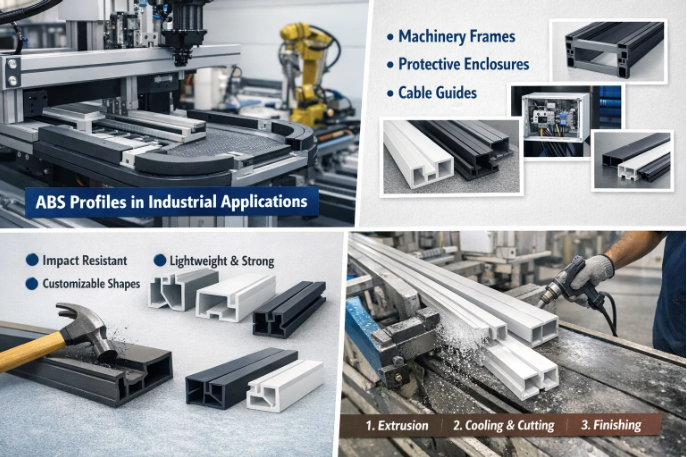
Walk into any factory, equipment workshop, or assembly line and you will find plastic components working quietly in the background. Many of them are not visible, but they play a critical role in structure, protection, and functionality. In many projects, industrial ABS profiles solutions are chosen because they combine strength, precision, and practical performance in demanding environments.
From machine housings to technical frames, ABS profiles are widely used where durability and design flexibility are required. This article explains how ABS profiles work, where they are used, and why they matter in industrial manufacturing.
What Are ABS Profiles?
ABS profiles are extruded plastic components made from Acrylonitrile Butadiene Styrene (ABS), a strong and impact-resistant thermoplastic. These profiles are produced in specific shapes and dimensions to suit industrial and technical applications.
In simple terms, ABS profiles are shaped plastic parts used as structural or functional elements in machines, equipment, and industrial systems.
They are commonly used in:
- Machinery and equipment frames
- Protective covers and enclosures
- Technical channels and guides
- Structural components in industrial systems
Why ABS Is Suitable for Industrial Use
Industrial environments demand materials that can withstand mechanical stress, temperature variations, and repeated use.
ABS offers a balanced combination of properties:
- High impact resistance
- Good dimensional stability
- Resistance to many chemicals
- Easy processing and fabrication
- Smooth surface finish
These features make ABS profiles suitable for both structural and aesthetic applications.
Key Benefits of ABS Profiles in Industrial Applications
1) Strength with lightweight structure
ABS profiles provide strong mechanical performance without excessive weight.
This helps:
- Reduce load on equipment
- Simplify installation
- Improve handling and assembly
In real production settings, lighter components often improve operational efficiency.
2) Impact resistance and durability
Industrial systems often face vibrations, shocks, and mechanical stress. ABS profiles are designed to absorb impact without cracking easily.
Benefits include:
- Longer service life
- Reduced risk of sudden failure
- Stable performance under stress
This is especially useful in moving parts and protective structures.
3) Design flexibility and customisation
One major advantage of ABS profiles is their ability to be customised.
Manufacturers can produce:
- Complex cross-sectional shapes
- Precise dimensions
- Functional features such as grooves and channels
In many projects, ABS plastic extrusion in product design allows engineers to integrate multiple functions into a single profile, reducing the need for additional components.
4) Surface quality and finishing options
ABS profiles offer smooth surfaces that can be easily finished or coated.
They support:
- Painting and coating
- Textured or glossy finishes
- Branding and colour coding
This makes ABS suitable for applications where appearance matters along with performance.
5) Resistance to environmental factors
While ABS is not designed for extreme outdoor exposure without additives, it performs well in controlled industrial environments.
Key advantages:
- Resistance to oils and greases
- Stability under moderate temperature ranges
- Good electrical insulation properties
These characteristics support safe and reliable industrial use.
Common Uses of Industrial ABS Profiles
Industrial ABS profiles are used across multiple sectors.
Typical applications include:
- Automation equipment components
- Electrical enclosures and panels
- Conveyor system parts
- Machine guards and covers
- Technical furniture and fixtures
For example, in an automation system, ABS profiles are used as protective housings for sensors and wiring. They provide structural support while protecting sensitive components from mechanical damage.
Manufacturers such as M3 Extrusion produce ABS profiles based on technical drawings and project requirements, supporting both customised production and bulk supply for industrial applications.
How ABS Profiles Are Manufactured
Step 1: Material selection and preparation
ABS granules are selected based on required properties such as impact resistance, heat tolerance, and surface quality.
Additives may be used to improve:
- UV resistance
- Flame retardancy
- Colour stability
Step 2: Extrusion process
The ABS material is melted and pushed through a specially designed die to form the required profile shape.
Key aspects of extrusion include:
- Temperature control
- Die design precision
- Cooling and calibration
This process ensures consistent dimensions and structural integrity.
Step 3: Cooling and cutting
After extrusion, profiles are cooled and cut to required lengths.
Quality checks are performed to ensure:
- Dimensional accuracy
- Surface finish
- Structural consistency
Step 4: Customisation and finishing
Profiles can be further processed based on application needs.
Options include:
- Drilling and machining
- Coating or painting
- Assembly with other components
This flexibility makes ABS profiles suitable for a wide range of industrial uses.
Comparison of ABS with Other Industrial Plastics
| Feature | ABS Profiles | PVC Profiles | Polycarbonate Profiles |
| Impact resistance | High | Medium | Very high |
| Heat resistance | Medium | Low–Medium | High |
| Surface finish | Excellent | Good | Good |
| Cost | Moderate | Low | High |
| Industrial suitability | High | Medium | High |
This comparison helps engineers choose the right material based on performance and cost requirements.
Practical Tips for Selecting ABS Profiles
When choosing ABS profiles for industrial projects, consider:
1) Application requirements
- Load-bearing needs
- Exposure to heat or chemicals
- Mechanical stress levels
2) Profile design
- Shape complexity
- Tolerance requirements
- Integration with other components
3) Production scale
- Customisation needs
- Bulk supply capability
- Consistency across batches
Evaluating these factors helps ensure that ABS profiles meet both technical and operational needs.
Key Takeaways for Industrial Buyers
- ABS profiles offer strength, durability, and design flexibility.
- Industrial ABS profiles support complex technical applications.
- Custom extrusion enables integration of functional features.
- Proper material selection improves long-term performance.
These points reflect how ABS profiles perform in real industrial environments.
Summary
ABS profiles play a practical role in industrial manufacturing by providing strong, lightweight, and adaptable components. Their impact resistance, customisation potential, and surface quality make them suitable for a wide range of applications.
By understanding material properties, manufacturing processes, and application requirements, engineers and manufacturers can select ABS profiles that support efficient design and reliable performance in industrial systems.
FAQs
1) What are ABS profiles used for in industrial applications?
ABS profiles are used in machinery components, protective covers, enclosures, and structural parts. They provide strength, impact resistance, and design flexibility. In industrial environments, ABS profiles support both functional and structural requirements while maintaining durability and dimensional stability.
2) What makes industrial ABS profiles different from standard plastic profiles?
Industrial ABS profiles are designed with higher performance requirements in mind. They offer better impact resistance, precise dimensions, and consistent material quality. These profiles are produced to meet technical specifications required in industrial systems, unlike general-purpose plastic profiles used in non-technical applications.
3) How are ABS profiles manufactured?
ABS profiles are manufactured through extrusion, where melted ABS material is shaped through a die. The profiles are then cooled, cut, and finished based on application needs. This process ensures consistent dimensions, surface quality, and structural performance across production batches.
4) Are ABS profiles suitable for custom designs?
Yes, ABS profiles are suitable for custom designs because extrusion allows complex shapes and precise dimensions. Manufacturers can produce profiles based on technical drawings and functional requirements. This makes ABS profiles ideal for applications where standard profiles do not meet design or performance needs.
5) How do ABS profiles compare with PVC profiles?
ABS profiles generally offer higher impact resistance and better surface finish than PVC profiles. PVC profiles may be more cost-effective, while ABS provides better mechanical performance. The choice depends on application requirements, environmental conditions, and budget considerations.
6) Can ABS profiles be used in harsh industrial environments?
ABS profiles can be used in many industrial environments where moderate heat, mechanical stress, and chemical exposure are present. With proper material formulation and design, they provide reliable performance. However, for extreme conditions, additional additives or alternative materials may be required.
21 comments
ivermectin australia
ivermectin australia
what is mobic
what is mobic
remeron generico
remeron generico
buy antibiotics for sinus
buy antibiotics for sinus
flagyl generic
flagyl generic
furosemide 20 mg price
furosemide 20 mg price
lasix medicine 40 mg
lasix medicine 40 mg
viagra long-term benefits
viagra long-term benefits
semaglutid kaufen
semaglutid kaufen
doxycycline for dogs dose
doxycycline for dogs dose
orlistat drugs.com
orlistat drugs.com
toradol pain relief overview
toradol pain relief overview
minoxidil 2% vs 5% shedding
minoxidil 2% vs 5% shedding
minoxidil effectiveness study
minoxidil effectiveness study
minoxidil expert faq
minoxidil expert faq
minoxidil distribution overview
minoxidil distribution overview
vardenafil 10 mg dose
vardenafil 10 mg dose
vardenafil food compatibility
vardenafil food compatibility
insurance medical policy
insurance medical policy
otitis media antibiotic overview
otitis media antibiotic overview
Food Impact Resource
Food Impact Resource
Comments are closed.